
Osteopenia and osteoporosis: how strength training can support stronger bones

Bones are living tissue. Like muscles, they respond to the forces placed on them. Carefully chosen resistance and weight-bearing exercise can be an important part of bone health—but the right starting point depends on your bone density, fracture history and overall health.
Osteopenia and osteoporosis are not the same
Both terms describe lower-than-expected bone mineral density (BMD), usually measured with a DXA scan. The T-score compares BMD with the average for a healthy young adult.
Osteopenia (low bone mass) | Osteoporosis | |
|---|---|---|
Typical DXA T-score | Between −1.0 and −2.5 | −2.5 or lower |
What it means | Bone density is below the usual young-adult range, but not in the osteoporosis range. | Bone strength is more reduced and fracture risk is higher. |
What guides care | A T-score alone does not show the full risk; age, previous fractures, medicines and fall risk also matter. | Requires a clinical assessment and may require medication as well as exercise and fall-prevention strategies. |
These categories are useful, but they are not the whole story: someone can fracture with a T-score above −2.5, and people with the same score can have different overall fracture risk. Your clinician can interpret a DXA result in context.
What resistance training does for bones
When muscles pull against resistance, they place a safe, controlled load through bone. Over time, this loading can help maintain or improve BMD at important sites such as the spine and hip. A 2024 systematic review and meta-analysis found that exercise added to medicine or supplements improved lumbar-spine BMD in postmenopausal women; effects varied by exercise type and bone site.
Resistance training also strengthens muscles and supports better physical function. That matters because stronger legs, hips and trunk, together with balance practice, can improve steadiness and help reduce falls—a major cause of fractures.
The benefits in everyday life
Supports bone density: progressive resistance and weight-bearing activity give bones a reason to maintain strength.
Builds muscle and confidence: stronger muscles make everyday movements such as standing, lifting and climbing stairs easier.
Improves balance and posture: a well-designed program includes balance and spinal-extensor work, which may help lower fall risk and support upright posture.
Works alongside medical care: exercise complements—not replaces—medication, adequate nutrition and clinical management where these are needed.
What exercise can look like
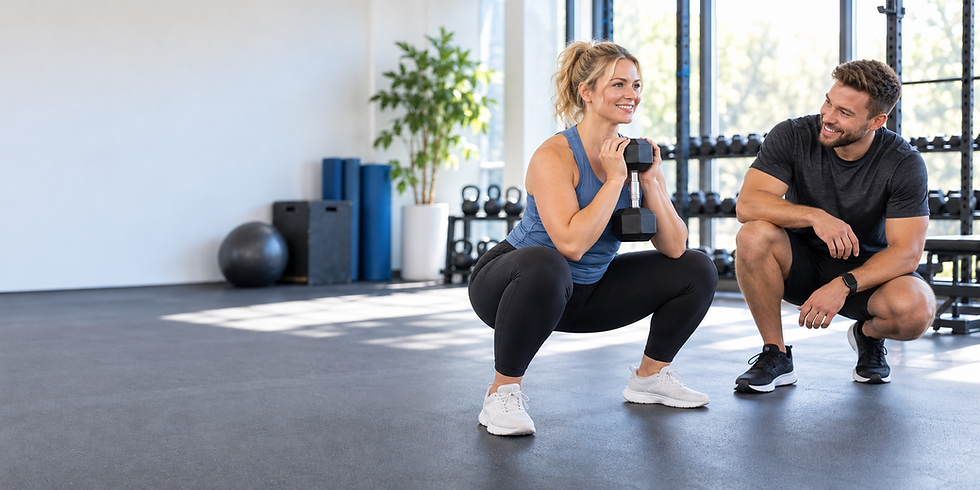
The strongest evidence supports a combined approach: progressive resistance training, weight-bearing movement that is appropriate for you, and balance work. Examples may include sit-to-stands, supported squats, step-ups, rows, wall push-ups, resistance-band exercises and supervised machine or free-weight work.
Current exercise guidelines for people with osteoporosis or osteopenia commonly recommend resistance training two or three times a week, progressed slowly with attention to technique. However, your plan must be individualised—especially if you have osteoporosis, a recent fracture, vertebral fractures, significant pain, balance concerns or other health conditions.
Important safety notes
Do not copy a high-impact or heavy-lifting program from the internet without guidance if you have diagnosed osteoporosis or a fracture history. An accredited exercise physiologist can tailor movements and loading to you. People with low spinal bone density or vertebral fractures may need to avoid loaded or forceful bending and twisting of the spine. Stop if you experience sharp pain, dizziness or a loss of control.
The goal is not to “work through” risk. It is to build capacity steadily, with an exercise plan that is safe enough to keep doing.
Journal references
Osteopenia: a key target for fracture prevention. The Lancet Diabetes & Endocrinology. 2024;12(11):856–864. doi:10.1016/S2213-8587(24)00225-0. https://doi.org/10.1016/S2213-8587(24)00225-0
Effects of exercise on bone density and physical performance in postmenopausal women: A systematic review and meta-analysis. PM&R. 2024;16(12):1358–1383. doi:10.1002/pmrj.13206. https://pubmed.ncbi.nlm.nih.gov/39032163/
Position Statement: Exercise Guidelines for Osteoporosis Management and Fall Prevention in Osteoporosis Patients. Journal of Bone Metabolism. 2023;30(2):149–165. doi:10.1105/jbm.2023.30.2.149. https://pmc.ncbi.nlm.nih.gov/articles/PMC10345999/
Brooke-Wavell K, Skelton DA, Barker KL, et al. Strong, steady and straight: UK consensus statement on physical activity and exercise for osteoporosis. British Journal of Sports Medicine. 2022;56(15):837–846. doi:10.1136/bjsports-2021-104634. https://doi.org/10.1136/bjsports-2021-104634


Comments